What the Somatic Enneagram Taught Me About Becoming
In early May, I attended a Somatic Enneagram Family Constellation retreat. While I expected to learn more about my Enneagram type, what I discovered was much deeper. The experience became less about understanding my personality and more about uncovering the patterns, beliefs, and unconscious loyalties that have shaped my life.
I also had the opportunity to learn from and experience other Enneagram types, including Tom's Type 6, which gave me a deeper appreciation for how differently we each navigate the world while sharing many of the same universal needs.
I am an Enneagram Type 2.
Most descriptions call Type 2 "The Helper." On the surface, that fits. Twos are caring, generous, intuitive, nurturing, and deeply attuned to the needs of others. We often notice what others need before they do and find genuine joy in supporting, encouraging, and caring for those around us.
For much of my life, those qualities have been central to who I am.
As a nurse, I cared for patients.
As a mother, I cared for my children.
As a wife, I cared for our family.
As a coach and instructor, I cared for my clients and students.
These roles have brought tremendous meaning and purpose to my life. Yet beneath the gift of helping is often a hidden belief:
If I am needed, I will be loved.
Most Twos don't consciously think this way. Instead, it quietly shapes how we move through the world. We become experts at sensing the needs of others while often overlooking our own. We learn to derive value from being helpful, reliable, and indispensable.
The question that surfaced during the retreat was both simple and unsettling:
Who am I when I am not taking care of someone else?
Family constellation work pairs beautifully with the Enneagram because both seek to bring unconscious patterns into awareness. Together, they reveal the ways we may carry responsibilities that were never ours, inherit beliefs and emotional patterns from previous generations, or confuse self-sacrifice with love.
This work also intersects with the emerging field of epigenetics, which suggests that the experiences of our ancestors, including trauma, stress, and survival responses can influence how genes are expressed across generations. Family constellation work offers a powerful experiential lens through which we can explore these inherited patterns and bring greater awareness to what may be shaping our lives beneath the surface.
As I participated in the constellation work, I found myself reflecting on how often I had equated worthiness with service. Not because anyone explicitly taught me that, but because it became a way of belonging.
If I help, I belong.
If I care for others, I matter.
If I am needed, I am valued.
The retreat invited me to consider another possibility:
What if I am worthy even when I am not helping?
What if my value does not depend on what I can do for others?
What if my presence alone is enough?
These questions felt less like intellectual exercises and more like invitations into a new way of being.
One of the insights that stayed with me from the retreat was the relationship between presence and power. For years, I viewed them as separate qualities. Presence felt soft and receptive, while power felt strong and active.
What I began to understand is that authentic power arises from presence. When we are grounded in ourselves and aligned with our truth, there is less need to prove, perform, or strive. We simply become more fully ourselves.
During the retreat, we completed an exercise using colored felt circles placed on the floor. One represented me in the present moment, one represented my healthy ancestors, and one represented an obstacle. Without much thought, I chose my younger self to represent the obstacle.
The invitation was simple: stand on each circle, become present in the body, and notice what emerged.
It wasn't until later that I realized what that choice revealed.
As I stood on the felt representing my healthy ancestors, I felt a surprising sense of strength, love, and support. Standing on the circle representing my younger self, I was caught completely off guard. What surfaced was not tenderness or compassion, but a deep sense of judgment that I had never fully recognized.
As I stayed with the feeling, I realized there was a part of me that blamed myself for being vulnerable. A part that believed I should have known better, been stronger, been more guarded. A part that felt disappointed that I had not protected myself from life's hurts and disappointments.
The realization was startling.
I had spent so much of my life extending compassion, understanding, and grace to others, yet there was a part of me that had withheld those same gifts from myself.
Standing there, I could see that what appeared to be self-criticism was actually a protective strategy. Somewhere along the way, I had learned that vulnerability was unsafe and that if I could just be stronger, wiser, or more careful, I could avoid pain.
But beneath that strategy was a deeper truth:
The vulnerable parts of me were never the problem.
They were simply the parts that needed love the most.
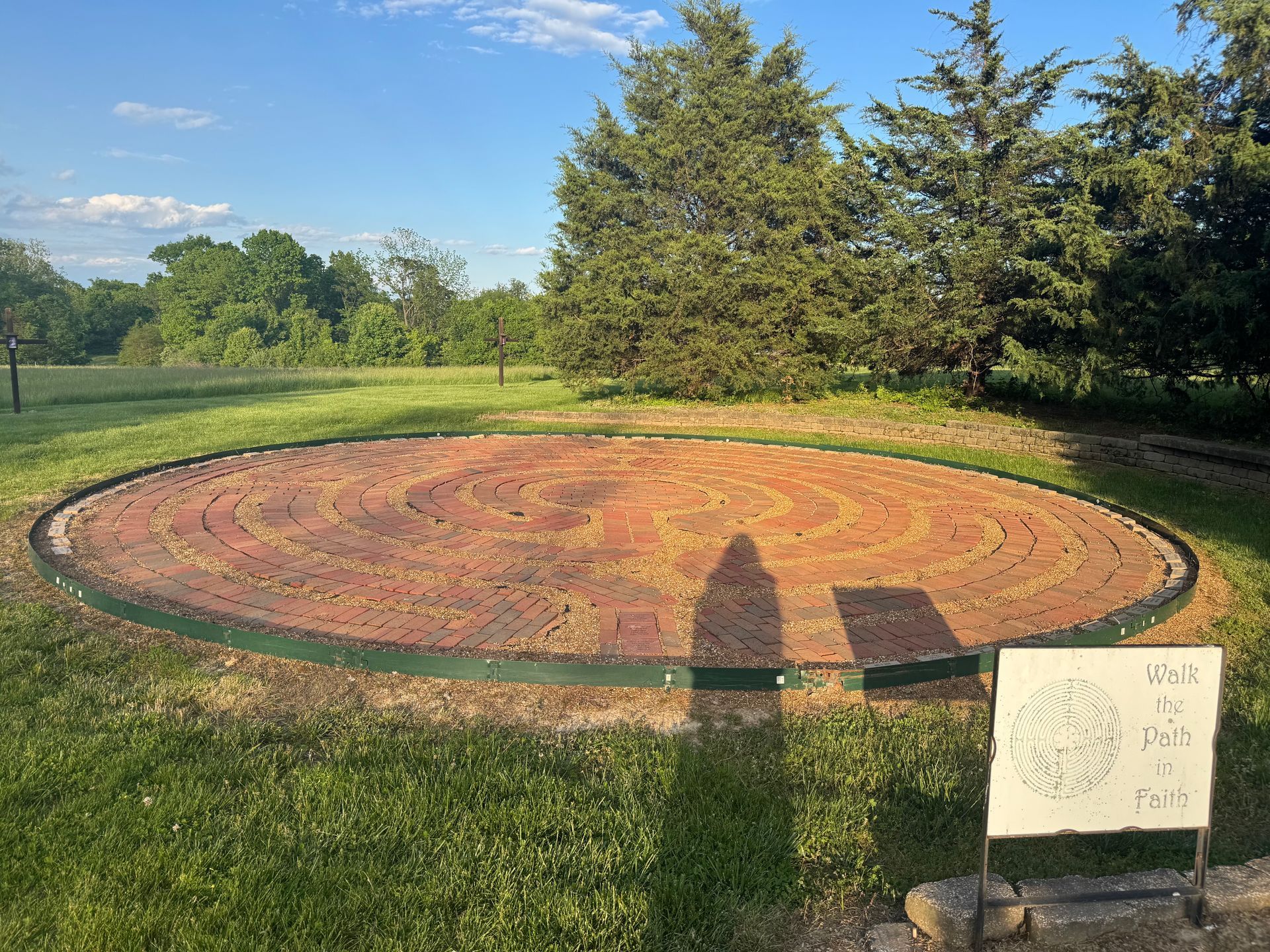
Another practice that became a meaningful part of my retreat experience was walking the labyrinth each day. Nestled among the peaceful grounds of the Pallottine Renewal Center, the labyrinth offered a quiet space for reflection and integration.
As I followed the winding path, I found myself thinking about how often we expect healing to unfold in a straight line. We want progress to be predictable. We want clarity to arrive quickly. We want to leave old patterns behind and never revisit them.
Yet the labyrinth tells a different story.
At times, the path brings you closer to the center. At other times, it seems to lead you away. There are moments when you wonder if you are moving in the right direction at all. Yet with each step, you are exactly where you are meant to be.
It felt like a metaphor for my own journey.
For years, I believed growth meant becoming someone better, stronger, wiser, or more evolved. What I am beginning to understand is that healing is often less about becoming someone new and more about returning to who we have always been beneath the layers of protection, performance, and expectation.
The labyrinth reminded me that becoming is not a straight path. It unfolds in spirals, inviting us to revisit old places with new awareness, deeper compassion, and a greater capacity to receive ourselves exactly as we are.
In that moment, I began to understand the relationship I had been carrying with myself. Beneath the helping, achieving, and caring for others, I could see traces of self-rejection—subtle ways I had judged myself, pushed myself, or believed I needed to earn my worth.
Rather than meeting those parts with criticism, I found myself meeting them with love. Not because they were wrong, but because they had been trying to protect me and help me belong.
For perhaps the first time, I could hold those patterns with compassion and recognize that healing begins when we stop fighting ourselves and start embracing all that we are.
This realization also deepened my understanding of the feminine—not femininity as appearance or role, but as energy.
An energy of receiving.
Of trusting.
Of allowing.
Of creating rather than controlling.
Of listening rather than pushing.
Of resting without guilt.
For many years, my growth focused on what I could do, achieve, learn, build, or contribute. Those pursuits were valuable and important. Yet this season feels different.
It feels less about doing and more about receiving.
Receiving support.
Receiving love.
Receiving abundance.
Receiving rest.
Receiving the truth that I do not need to earn what has always been available to me.
As I reflect on the retreat, I realize it was not about becoming someone new. It was about releasing the beliefs that prevented me from fully being myself.
The gifts of a Type 2 are beautiful. I do not want to stop caring. I do not want to stop serving. I do not want to stop loving.
But I am learning that healthy service does not require self-abandonment.
Healthy love includes the self.
Healthy giving requires receiving.
And true belonging begins when we stop performing for love and allow ourselves to simply be loved.
If you are someone who has spent your life caring for others, holding everything together, or measuring your worth by what you can do for those around you, perhaps this question is worth asking:
Who are you when you are no longer trying to earn love?
The answer may not be found in becoming someone new.
It may be found in remembering who you have been all along.
-Elizabeth